
This is one of the most common questions Brisbane homeowners ask.
The problem is, most advice online is generic. It doesn’t take into account Brisbane’s climate, the type of homes we have in suburbs like Sandgate, Brighton and Deagon, or how pest control products actually perform in real conditions.
After working in these areas for years, there are very clear patterns that explain why timing pest control properly makes a huge difference.
What pests in Brisbane are seasonal, and which are active all year?
From November through to March, as the heat and humidity build, pest activity ramps up quickly. This is when people start noticing bugs everywhere and assume something has suddenly gone wrong in their home.
In reality, this is simply Brisbane summer doing what Brisbane summer does.
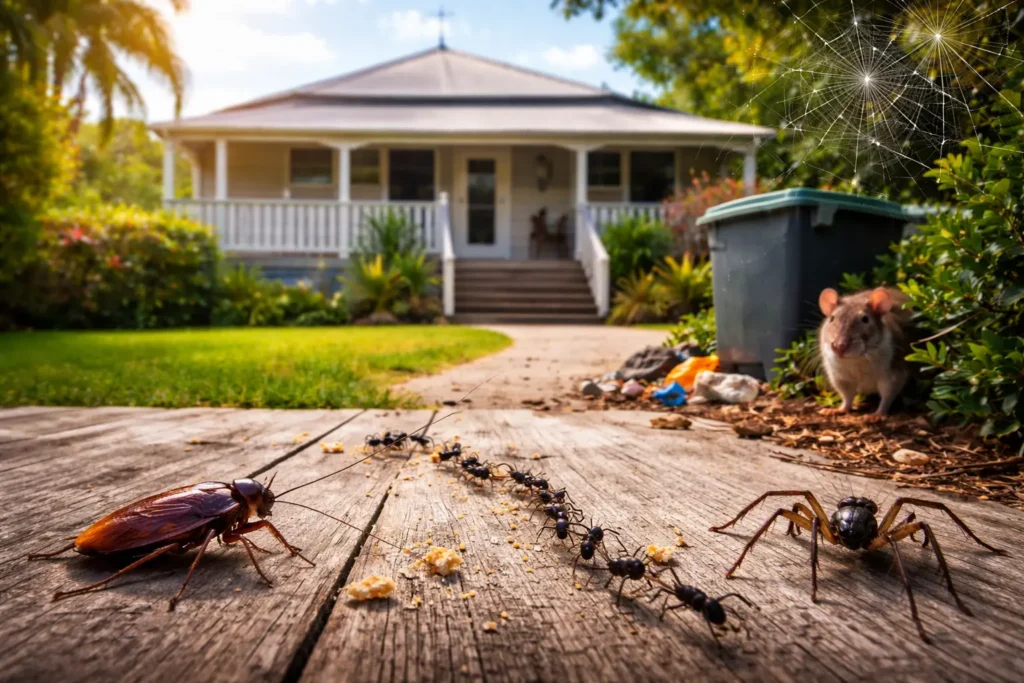
During this period, the most noticeable pests are:
-
Mosquitoes and midges
-
Cockroaches, especially outdoors around patios and drains
-
Webbing spiders around eaves, fences and gardens
-
Ants, which become far more aggressive after rain and storms
The combination of heat, moisture and vegetation growth creates ideal breeding conditions. Summer rain is a big trigger, particularly for ants, which often move closer to homes after heavy weather.
What many homeowners do not realise is that some pests never really go away.
Even through winter, we still see:
-
Cockroaches sheltering in warm areas
-
Spiders rebuilding webs in protected spots
-
Ants nesting in walls, gardens and under slabs
-
Rodents looking for warmth and food sources
They are simply less visible. Once the warmth returns, they become active very quickly, which is why people feel like the problem appeared overnight.
In Brisbane, pest pressure is year round, with certain pests peaking heavily in summer.
How often should general pest control be done for a Brisbane home?
So, how often should general pest control in Brisbane, Most professional pest control products come with label guidance that outlines:
-
Three months effectiveness externally
-
Six months effectiveness internally
This is not because the treatment suddenly stops working at that point. It is because that is the period the manufacturer is prepared to warranty under all conditions.
In practice, treatments often last longer than this. However, in Brisbane, weather is the deciding factor.
As a general rule:
-
Internal treatments will usually remain effective for six to twelve months
-
External treatments will usually remain effective for three to six months
This depends heavily on:
-
Rainfall and storms
-
Irrigation and watering
-
Garden growth and vegetation
-
Direct sun exposure to treated areas
A very wet summer can significantly shorten the life of an external treatment. A mild, dry period can extend it.
There is another factor most homeowners do not realise also affects how long a treatment lasts, and that is how clean the surfaces are when the treatment is applied, and how they are cleaned afterwards.
When a pest technician treats internal surfaces, the chemical bonds to the surface. If the skirting boards, floors and edges are dusty or dirty, the treatment bonds to the dust instead of the surface. This reduces the residual life.
Likewise, if the homeowner mops right up to the skirting boards or washes the treated edges immediately after the service, much of that residual is removed.
If those areas are left undisturbed for a few weeks after treatment, the residual effect will generally last much longer.
This is why house construction type does not make a big difference. What matters far more is:
-
Exposure to weather and environmental conditions
-
The cleanliness of surfaces at the time of treatment
-
How the home is cleaned after the service
For most Brisbane homes, a realistic expectation is:
-
Internals once per year
-
Externals every three to six months depending on conditions
The biggest mistake homeowners make
The most common mistake is waiting until pests are visible before doing anything.
By the time you are regularly seeing cockroaches, ants, spiders or rodents, the problem has usually been building for a long time without you realising it.
Pest control works best as a maintenance routine, not as a reaction.
When a home goes two or three years without any general pest treatment, pest populations can build up quietly in roof voids, wall cavities, gardens and subfloors. Then, when conditions are right, especially in summer, it feels like pests have suddenly taken over the house.
A rule of thumb I often tell customers is:
For every cockroach you see, there are a hundred you don’t see.
Regular treatments, at least every 12 months internally, significantly reduce the risk of hidden infestations developing.
What happens when treatments are left too long
A very common example we see is with German cockroaches.
These are very different to the larger outdoor cockroaches people are used to seeing. German cockroaches breed extremely quickly.
What starts as just a few in a kitchen or laundry can become:
-
Hundreds within a few months
-
Thousands a few months after that
By the time the homeowner realises there is a serious problem, eradication becomes far more difficult, time consuming and costly.
This is what happens when pest control is left until a problem is obvious instead of being managed regularly.
Recommended treatment frequency for different pest issues
General pest control
For commercial premises, there are often compliance requirements that require treatments at least every three months.
For residential homes, a practical recommendation is:
-
Internal treatment at least once every 12 months
-
External treatment every six months
Ant problems
Ants are highly seasonal and are far more active during the warmer, wetter months.
A standard general pest treatment does not always properly address an ant infestation. There are many different ant species and each can require a different approach.
If ants are a problem, it is best to speak directly with your pest technician for specific advice.
Mosquito management
Mosquitoes are attracted to cool, shaded areas and thick foliage. Prevention is often more effective than treatment.
Because they are flying insects, treating one property in isolation often has limited effect if surrounding properties have heavy vegetation. In suburban areas, the best results often occur when neighbours work together to treat the broader area.
Rodent control
Rodents reproduce quickly and can cause significant damage and spread disease.
Key steps are:
-
Removing food sources
-
Reducing rubbish and clutter
-
Sealing entry points into the home
If rodents are heard or seen, it is best to act quickly before the problem escalates.
Termite inspections
Termites are responsible for a large amount of damage to Australian homes. It is often said that one in three homes will be affected at some point.
A professional termite inspection should be carried out at least every 12 months to detect activity before serious damage occurs.
The simple answer
If you want to avoid pest problems instead of reacting to them, the simplest plan for a Brisbane home is:
-
Internal pest treatment once per year
-
External pest treatment every six months
-
Annual termite inspection
This works with Brisbane’s climate, how pests behave locally, and how pest control products are designed to perform.
Pest control is not something you do when you have a problem. It is something you do so you never have one.